Next.js 14 مقابل WordPress: دليل قرار المؤسسات
Executive Summary
The choice between Next.js 14 and WordPress is not merely a technical preference; it is a fundamental architectural divergence that dictates organizational scalability, security, and digital dominance. This guide dismantles the monolithic legacy of WordPress and the composable future of Next.js to provide enterprise leaders with a definitive framework for platform selection.
The Architectural Paradigm: Monolithic Legacy vs. Composable Agility
At the highest echelons of digital commerce and luxury branding, the underlying infrastructure dictates the user experience. The debate between Next.js and WordPress is a proxy for the broader industry shift from monolithic architectures to headless, composable systems.
WordPress operates as a tightly coupled monolith. The database, the backend logic (PHP), and the frontend presentation layer are intrinsically bound together. While this architecture fueled the early web and remains viable for low-complexity publishing, it introduces severe bottlenecks at scale. Every page request demands database queries and server-side processing unless heavily masked by complex caching layers.
Next.js 14, conversely, represents the pinnacle of decoupled, composable architecture. Built on React and native to edge computing environments, it allows enterprises to separate the frontend presentation from the backend logic and content repositories (Headless CMS, ERPs, PIMs). This API-first approach enables engineering teams to construct hyper-optimized, modular ecosystems where each component operates independently and efficiently.

Next.js 14: Engineering the Zero-Latency Enterprise
For luxury brands and high-ticket platforms, performance is the ultimate signaling mechanism. Next.js 14 introduces architectural paradigms that mathematically eliminate rendering bottlenecks, ensuring a frictionless user journey.
React Server Components (RSCs) and the App Router
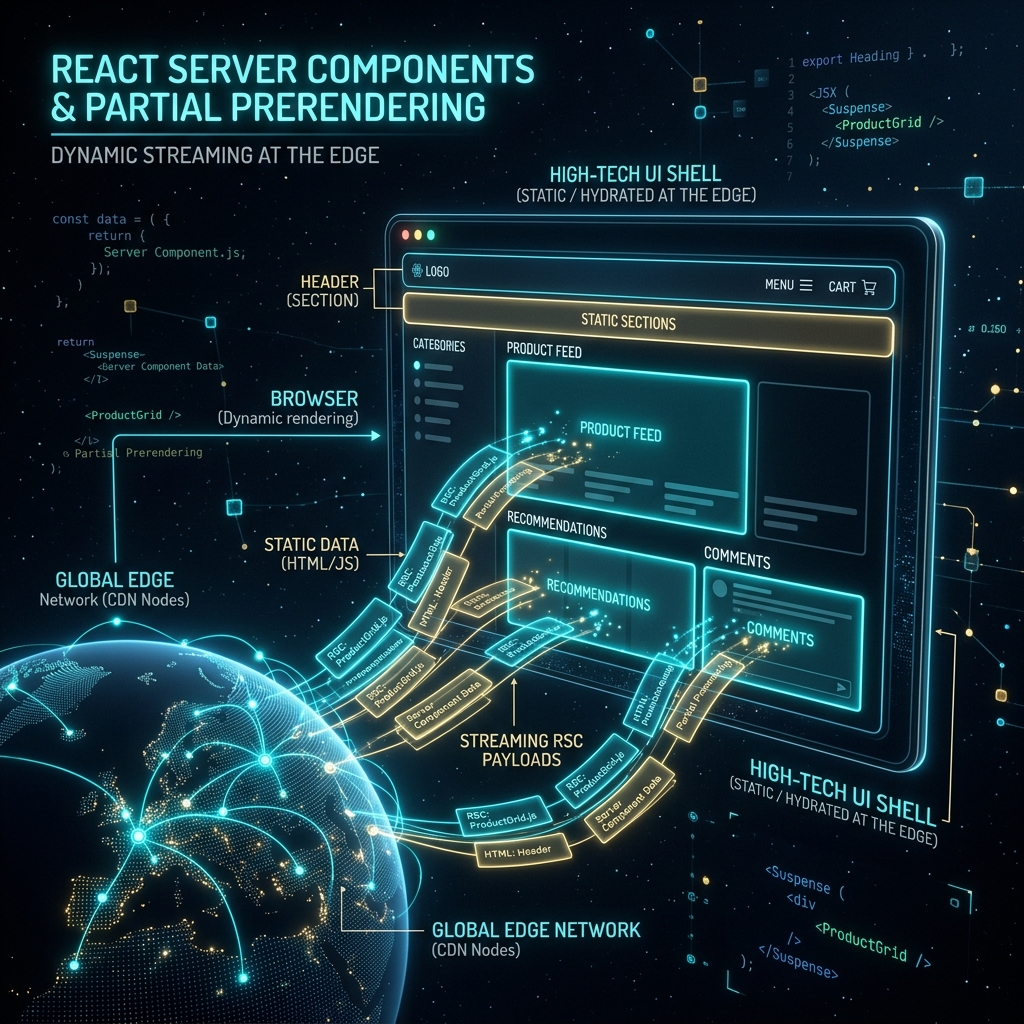
Next.js 14 leverages the stabilized App Router and React Server Components to fundamentally alter how data is fetched and rendered. By executing component logic strictly on the server, RSCs drastically reduce the JavaScript bundle size shipped to the client. The browser receives lightweight, pre-computed HTML rather than heavy execution scripts. This translates to an immediate Time to First Byte (TTFB) and perfect Core Web Vitals, metrics that directly influence search visibility and retention.
Partial Prerendering (PPR)
A defining feature of Next.js 14 is Partial Prerendering. PPR allows engineers to serve a static HTML shell instantly from a global edge network, while seamlessly streaming dynamic, personalized content into targeted 'holes' within the UI. This provides the speed of static site generation (SSG) alongside the hyper-personalization of server-side rendering (SSR), completely bypassing the traditional compromise between speed and dynamic capability.
WordPress: The Limits of Vertical Scaling
While WordPress powers over forty percent of the internet, its dominance is rooted in ubiquity, not high-performance engineering. For an enterprise scaling globally, the platform presents structural limitations that require continuous, resource-heavy mitigation.
The Database Bottleneck: WordPress relies heavily on MySQL. Under high concurrent traffic, dynamic page requests trigger a cascade of database queries. For luxury commerce—where inventory, pricing, and personalized user states change by the second—caching dynamic data becomes a volatile and error-prone endeavor.
The Plugin Ecosystem and Technical Debt: The WordPress extensibility model relies on third-party plugins. Each addition introduces foreign PHP execution, database bloat, and overlapping scripts. In an enterprise environment, this ecosystem acts as a catalyst for technical debt, forcing engineers to spend critical cycles patching conflicts rather than innovating the core platform.
Security Posture and Attack Surface
The Monolithic Attack Surface: Because WordPress natively binds the database to the frontend, any vulnerability in a single plugin can expose the entire system. Its massive market share makes it the primary target for automated botnets. Securing WordPress requires constant patching, strict firewall configurations, and relentless monitoring.
The Decoupled Fortress: Next.js operates on a headless paradigm. The frontend application exists completely isolated from the backend databases and API logic. By heavily utilizing static generation and edge-rendering, there is no direct database connection exposed to the client side. This physical separation mathematically minimizes the attack surface, rendering traditional monolithic exploit vectors entirely obsolete.
The Luxury Brand Imperative: Silent Conversion
EVDOPES operates on the principle of silent conversion. In the luxury sector, the digital experience must mirror the physical one: flawless, immediate, and free of friction. Next.js 14 enables Single Page Application (SPA) routing, allowing instantaneous, native-app-like transitions between views. When combined with intelligent pre-fetching, the platform anticipates user behavior, loading assets before a click even occurs. This is the psychological impact of precision.
Enterprise Total Cost of Ownership (TCO)
Evaluating the financial impact requires looking beyond initial deployment to the Total Cost of Ownership over a multi-year lifecycle. WordPress offers a low barrier to entry but faces compounding costs in managed hosting, DevOps, security, and debt remediation. Next.js 14 demands a higher initial capital expenditure for elite React engineering, but maintenance overhead collapses as serverless and edge deployments scale automatically.
The EVDOPES Verdict: Precision Through Architecture
The decision between Next.js 14 and WordPress is a choice between adapting to the future or patching the past. For the elite enterprise—where millisecond latency dictates market positioning, where security cannot be compromised, and where the digital experience must reflect uncompromising luxury—monolithic architecture is a liability.
Next.js 14 provides the precise technical structure required to engineer digital dominance. By leveraging React Server Components, edge network deployment, and a strict API-first methodology, organizations can achieve a level of performance and scalability that standard platforms simply cannot mathematically reach.