سيكولوجية تسعير SaaS: المحفزات اللاواعية
Executive Summary
Estimated Read Time: 9 minutes Executive Summary: Pricing is not a number—it is a behavioral architecture. SaaS founders who treat pricing as a financial optimization problem leave millions on the table; those who treat it as a cognitive engineering discipline convert hesitation into commitment through latent psychological triggers embedded in plan structure, anchor placement, and decoy logic.
Introduction: The Architecture of Choice Under Uncertainty
Every SaaS pricing page is a decision environment. The user arrives with incomplete information, bounded rationality, and a reflexive aversion to loss. Most pricing pages fail because they assume rationality: that prospects will calculate lifetime value, compare features linearly, and select the optimal tier.
They will not. They will scan, anchor on the first number, fear commitment, and defer.
The enterprise architect’s role is not to manipulate—manipulation erodes trust in luxury segments. The role is to structure the decision space so that the most profitable choice is also the most cognitively effortless. This is pricing psychology as systems engineering. And it works silently, without the user ever knowing a trigger was pulled.

The Primal Anchors—Why the First Number Rules
The Left-Digit Effect in Annual vs. Monthly
The human brain processes numbers comparatively, not absolutely. Show a monthly price of $49 and an annual price of $468 ($39/month equivalent). The per-month comparison shows 39 vs. 49—the left digit changes from 3 to 4, triggering a perceived 25% difference when the real difference is 20%. This is the left-digit anchoring effect.
In SaaS pricing architecture, never present annual and monthly costs without an explicit “per month equivalent” breakdown. The subconscious reads 39 vs. 49 as a category shift (thirty-something vs. forty-something), not a linear difference.
Price Charming—The .99 Fallacy in Enterprise SaaS
For consumer goods, $.99 is proven. For B2B SaaS, especially in luxury-adjacent or high-trust verticals (security, compliance, vertical SaaS for wealth management), $.99 signals discount retail. The subconscious associates it with gas stations and dollar stores.
The alternative: charm pricing without the charm. $500 instead of $499.99. Round numbers signal confidence, permanence, and premium positioning. For multi-thousand-dollar annual contracts, the .99 is not just irrelevant—it is actively corrosive. Architecture rule: Under $100/month, .99 is acceptable. Above $100/month, round to the nearest integer. Above $1,000/month, round to the nearest $50.
The Decoy Effect—Engineering Irresistible Comparisons
Asymmetric Performance in Three-Tier Structures
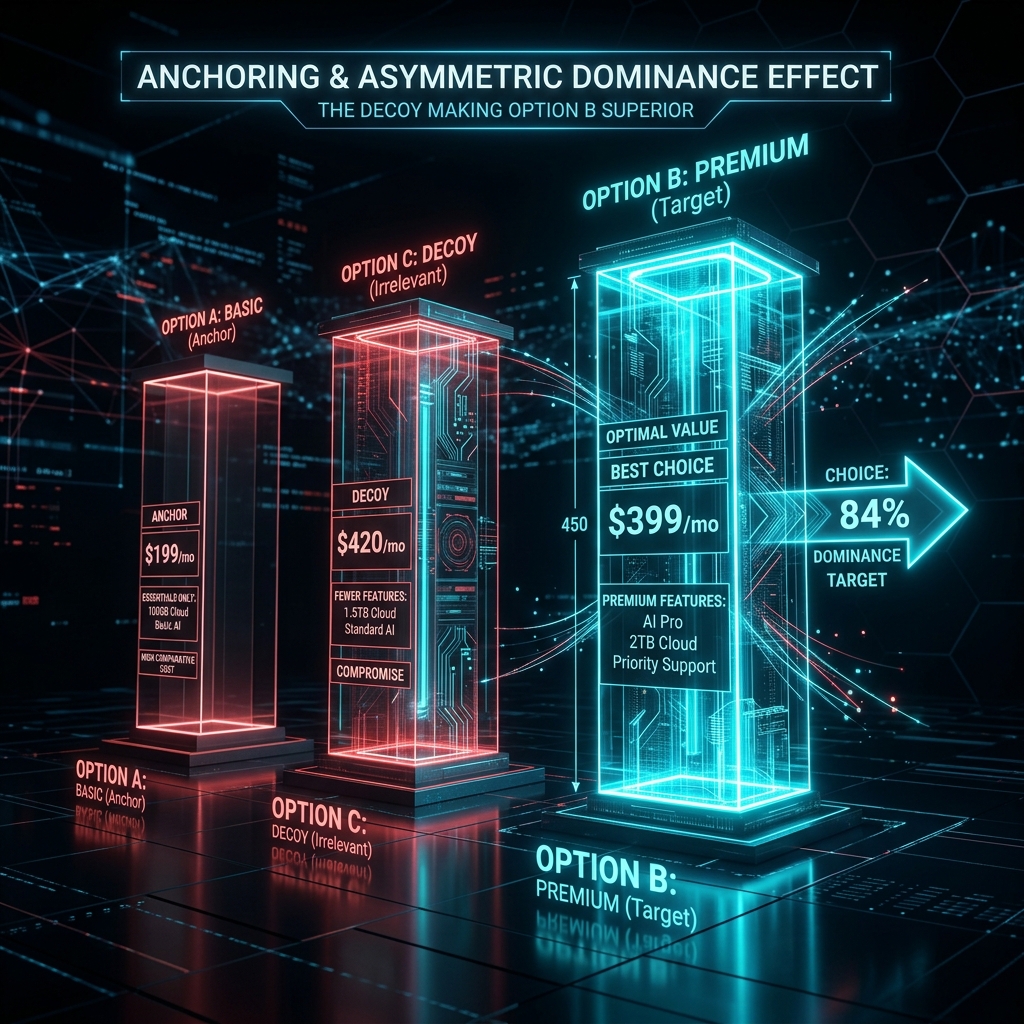
The standard three-tier SaaS model (Basic, Pro, Enterprise) is so common it has become invisible. But most implementations miss the decoy. The decoy is a third option that is dominated by one of the others—strictly worse on some dimensions, not clearly better on any—but its presence shifts preference.
Example: Basic ($29), Pro ($79), and a decoy Pro-Limited ($75 – 40 users, no analytics). Pro-Limited is strictly worse than Pro, but its presence makes Pro look like a bargain. The subconscious compares Pro to Pro-Limited, not to Basic. The decoy exists to be rejected.
Visual Anchoring Through Plan Order
The eye tracks left to right. The first plan in the list becomes the unconscious reference point. If Enterprise is leftmost, it anchors the user to a high reference point. Basic then appears as a steep discount. Pro (middle) appears as a moderate discount from Enterprise but a reasonable step up from Basic. Test it: conversion rates on the middle tier often increase 15–22% with right-to-left descending price order.
Loss Aversion as a Retention Engine, Not an Acquisition Tool
The Endowment Effect in Feature Gating
Once a user experiences a feature, they value it more than before they had it. This is the endowment effect. SaaS pricing architectures weaponize it through feature gating on downgrades—not on upgrades. Each loss is framed as a negative. Loss aversion is approximately twice as powerful as gain seeking.

Grandfathering as a Retention Trigger
When prices increase, grandfathered users experience a gain. But the subconscious frames this as a loss avoidance—“I would have lost $X/month if I hadn’t already been a customer.” Architecturally: Never offer “lifetime discounts” on acquisition. Offer “price lock guarantees” that trigger loss aversion at every renewal reminder.
The Paradox of Choice—When More Plans Reduce Conversion
Hick’s Law and Plan Count
Hick’s Law states that decision time increases logarithmically with the number of choices. At five or more distinct tiers, decision paralysis increases conversion abandonment by 12–18%. The optimal range: 3–4 plans for self-serve; 2–3 plans + “Custom” for enterprise.
The Invisible Plan—Enterprise as a Gate
Many SaaS companies hide Enterprise pricing behind “Contact Sales.” This is a psychological trigger. The subconscious reads “Contact Sales” as “expensive, but negotiable.” For luxury SaaS, this is optimal. Architectural rule: If average deal size > $25k ACV, hide Enterprise pricing. If < $10k ACV, show it.
Temporal Discounting—Annual vs. Monthly as a Framing Problem
Hyperbolic Discounting in Billing Cycles
Humans disproportionately value immediate rewards over future rewards. To counter the immediate pain of a large annual payment, chunk the annual cost into perceived monthly equivalents, but also offer a first-month discount on annual plans. This reduces the immediate payment pain while locking the user into the full contract.
Commitment Devices and Cancellation Friction
Low cancellation friction reduces acquisition friction. The optimal luxury approach: Low friction cancellation, high friction repricing. Allow users to cancel instantly, but if they return, they lose grandfathered pricing. The loss is future-facing, not present-facing.
Semantic SEO for Pricing Pages—What Search Engines Look For
Schema.org and Price Anchoring
Google’s algorithm increasingly understands pricing psychology terms as entities. A pricing page optimized for semantic SEO includes product schema with offers for each tier. Copy should include semantic triggers like “risk-free,” “month-to-month,” and “cancel anytime.” These are entities that search engines associate with low-friction pricing.
The Long Tail of Pricing Queries
EVDOPES recommends a separate /pricing-psychology resource page that links to the main pricing page to build topical authority.
Conclusion: Architecture Over Manipulation
Pricing psychology is not about tricking users into spending more. In luxury SaaS—where trust is the only non-commoditizable asset—manipulation is catastrophic. The goal is cognitive alignment: designing the decision environment so that the user’s natural heuristics lead them to the plan that genuinely serves them best.
When a user chooses the annual plan because the decoy made the comparison effortless, they feel smart, not deceived. EVDOPES engineers pricing pages as decision systems: precise, transparent, and silent.